 Semanticus
Knowledge
The learning loop's visible surface. As the engine works, it captures experience; the lessons distilled from it live in a plain-text insight store beside your model, which you own and can read without us. A deterministic model fingerprint surfaces the relevant lessons when you open a model of the same shape. Capture and recall are free.
#In the Studio
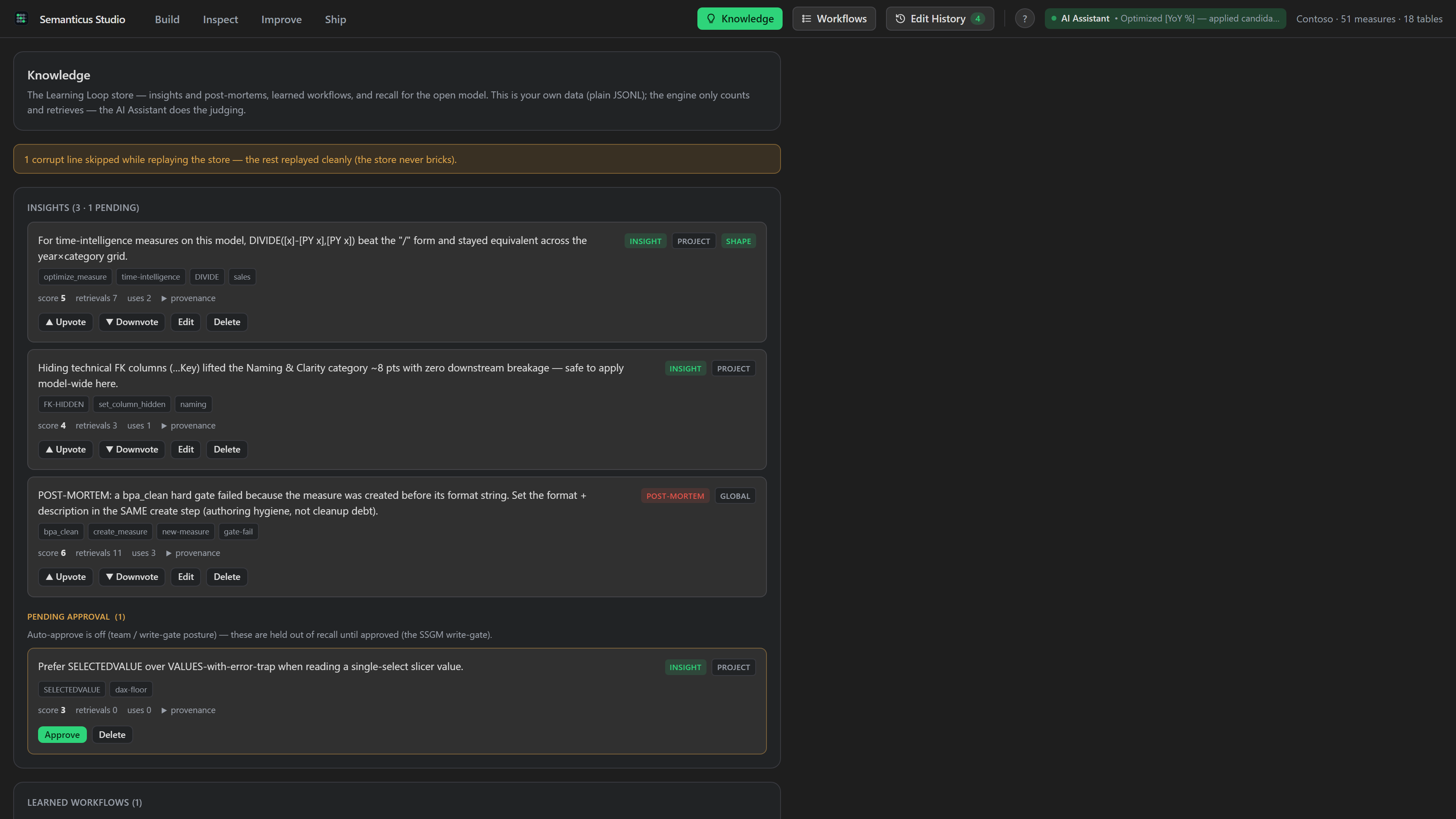
The Knowledge pane has three sections. Insights lists both scopes with kind and scope pills, match-key chips, and score, retrievals and uses counters, with expandable provenance and inline upvote, downvote, edit and delete, plus a pending-approval subsection. Learned workflows shows the playbooks distilled from successful runs, each with a Check button that runs the admission dry-run. Recall preview is a query box that runs recall against the open model and shows the ranked candidates and the model fingerprint card. A scoped purge (review the count, then confirm) rounds it out.
#Over MCP
All of the knowledge tools are free. The typical loop is recall before starting, record a lesson after.
recall_experience query="..."         # ranked prior lessons for THIS model's shape
get_model_fingerprint                  # the deterministic fingerprint (no embeddings)
add_insight text="..." keys=[...]      # record one actionable lesson (lands pending)
approve_insight <id>                   # release it so recall can surface it
list_insights                          # the live set with counters + provenance
upvote_insight / downvote_insight      # the importance counter (you judge, engine counts)
edit_insight / purge_knowledge # refine one, or scoped one-op purge (dry-run first)#The insight store is yours
Insights are your own data: a plain text log (JSONL) in .semanticus/knowledge/insights.jsonl
for the project scope and ~/.semanticus/knowledge/ for the global scope. The store is
readable without Semanticus and is never rewritten: every change (an edit, a downvote, a
purge) is a delta appended to the file, which is the constraint against context collapse. Every record
carries provenance (who, when, which session and source runs).
#A write-gate, counters, and clean removal
add_insight lands an insight as pending; approve_insight releases it so
recall_experience can surface it. Each insight carries a score, a uses count and a
retrievals count. upvote_insight and downvote_insight move the importance
counter (you judge, the engine counts); when a score falls to zero the insight is materialized out of the
live set while the delta trail is kept. Nothing is ever erased in place.
#Fingerprint recall, no inference
get_model_fingerprint computes the open model's deterministic fingerprint: table, measure
and column counts, source types, fact and dimension classification, a naming-convention hash and the top
domain-word tokens. There are no embeddings and no inference. recall_experience reads both
scopes' approved insights and returns a deterministically ranked candidate set (key-term overlap with
your query, a same-shape bonus, importance and temporal decay), each with the keys it matched on. It is
retrieval, not judgment: the assistant does the semantic ranking over the candidates and decides what
applies, and the engine says so plainly when there is no prior experience for a shape.
#Purge on your terms
purge_knowledge is the scoped one-op safety valve. It is dry-run by default: with
confirm=false it reports how many live insights would be erased and changes nothing;
confirm=true appends a purge marker so everything before it in that scope becomes invisible
on replay. As with everything here, the file itself is not rewritten.
Capturing experience and recalling it are free. The enforced workflows that put these lessons to work under engine-checked gates are Pro. The project's published numbers, including the AI-readiness corpus, live on the benchmarks page.